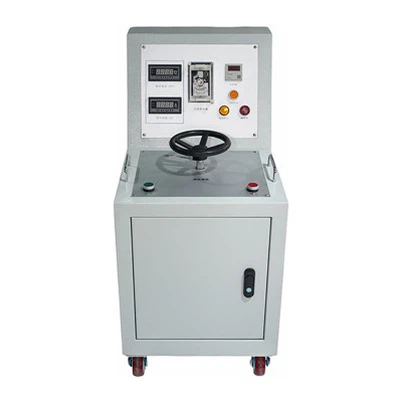

Manufacturing Process of High Voltage Testing Instruments
Leave a message
The manufacturing process of high voltage testing instruments is a comprehensive process integrating precision design, rigorous material selection, meticulous machining, and system debugging. Its core objective is to ensure the safety, stability, and measurement accuracy of the equipment under high voltage environments.
Main Manufacturing Process Flow
Design and Planning Phase: Based on the functional requirements of the high voltage testing instrument (such as AC/DC withstand voltage, insulation resistance testing, etc.) and technical specifications (output voltage range, accuracy class, safety protection mechanisms), the overall structural design is completed. This phase includes:
Electrical System Design: Determining the configuration of the step-up transformer, control circuit, and signal acquisition module;
Safety Interlock Design: Integrating functions such as zero-start, overvoltage and overcurrent protection, and rapid discharge;
Human-Machine Interface Design: Supporting digital display, parameter setting, and data storage.
Material Procurement and Inspection: Procure key components according to the design drawings, such as:
High-voltage transformer (must withstand high field strength and low partial discharge);
Insulating materials (e.g., epoxy resin, Nomex paper);
Electronic components (IGBTs, thyristors, high-voltage capacitors, rectifier diodes);
Casing and connectors (using moisture-resistant and flame-retardant materials).
All materials must pass quality inspection before use.
Core Component Processing and Assembly:
High-voltage transformer manufacturing: Employ segmented winding technology, using high-performance insulating materials between layers, and controlling the turns ratio to achieve precise voltage boosting (e.g., boosting from 220V to 4kV or 6kV);
Circuit board and control system production: Complete PCB assembly using SMT surface mount technology (SMT) and reflow soldering processes, and conduct functional testing;
Complete assembly: Integrate the mechanical structure, electrical system, control panel, and cooling system according to the drawings, focusing on ensuring the insulation distance between high-voltage components and the reliability of grounding.